The Process of Karma
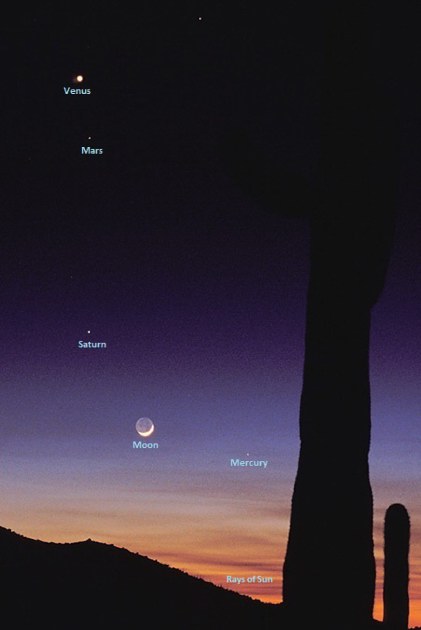
This beautiful snapshot of a rare planetary conjunction on May 13 2002 (edited by JyotishVidya 2012) magnificently captures the celestial display with the Sunlight reflected from Earth (earthlight) lighting up the surface of the Moon.
Permission to use photo courtesy of
Almost perfectly aligned these visible planets, along with Rahu, were all in the sign of Taurus. Sun was in Aries, his sign of exaltation. Missing from this celestial wonder is divine planet Jupiter (in sign of Gemini). The faint object (top, right of Venus) is a distant star.
According to Vedic tradition: Ego (Rishi) arises from the mind. The ego desires that which it perceives is lacking (not known). This initiates the process of knowing (Devata) which arises in the intellect. The known (Chandas) is then inventoried in the mind as memory, and it's from these stored memories that the desires of the ego rise again and again.
Rishi, Devata and Chandas: Rishi (I am, ego) is the knower and is ruled by Sun. Devata (intellect) is the process of knowing and is ruled by Mercury. Chandas (mind) is the known and is ruled by Moon.
Rishi is the knower or ego of the jiva. Each one of us senses this knower aspect of ourselves. It is that aspect that we identify as our Self. Rishi is a viewpoint of the universe that is uniquely personal, like a window through which an individual perceives the world.
Devata is the intellect or faculty of discrimination which connects the knower with the known, and completes the circuit that gives rise to knowledge.
Chandas: In the self-referral process of knowing, rishi becomes devata and devata becomes chandas and chandas is the new knowledge, which is the new rishi. The new rishi is different from the original rishi because of the assimilation of the knowledge.
|