Vedanga (limb of the Veda) 
This ancient wisdom, which was once available only to brahmins (priestly class), is now freely available to all who have access to the Internet. This is a wonderful boon for the sincere student, however it also has a down side as the budding student is exposed to a veritable minefield of misinformation.
According to the teaching of the rishis, the Janma Kundali (Vedic horoscope) is an act of Creation. We are taught that, at the moment of birth, the divine planets (NavaGrahas) manifest as a new entity (a new creation) and the Rasis (signs of the zodiac) manifest as the twelve Bhavas (houses of the horoscope). There should be no doubt that the sign that has become the bhava is an act of Creation as certain and unchangeable as the re-creation of the navagrahas (nine divine planets) at the moment of birth.
NB: The trans-Saturnine planets (Neptune, Uranus and Pluto) do not have this quality to recreate - perhaps due to their distance from our Sun who is known as the soul of all living beings. The indisputable fact, according to the sages, is that only the planets from Sun through to Saturn, along with the devious nakshatra (hidden in their midst), drank of the nectar of immortality which gave them the power to recreate each time an entity is born.
As the sages tell us, we are "the personification of the universe". When we're born, the divine planets (navagrahas) are no longer just physical objects in the sky and the signs of the zodiac, having manifested as the twelve bhavas, are no longer just visible constellations.
Having grasped this fundamental truth we can understand the vast difference between Vedic horoscope (Janma Kundali) and other horoscope systems that divide the houses into unequal portions and incorporate the trans-Saturnine planets.
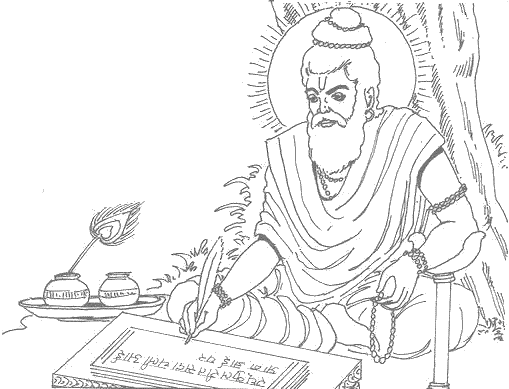
Scholars suggest that the great sage Parashara, whose discourses are given in "Brihat Parashara Hora Shastra", lived at the time of the Mahabharata war, about 3000 BC. - Parashara is taken by most astrologers to be the Father of Vedic astrology. However references in the Rig Veda (the oldest of the four Vedas) suggest that Jyotish (the name given to Vedic astrology) was a developed science even before Parashara's time.
The four collections of hymns namely; Rig Veda Samhita, Yajur Veda Samhita, Sama Veda Samhita, and Atharva Veda Samhita are said to have been revealed to the sages of India five or six thousand years ago.
Jyotish, a Vedanga (or limb) of the Vedas, is known as "the eye of the Veda"--the science which helps one see the life path. It includes astronomy, mathematics, cosmology, omenology, the setting of auspicious times, divination based on questions, and the interpretation of horoscopes. There are about thirty slokas on astrology in the Rig Veda; forty four in Yajura Veda and one hundred and sixty two in Atharva Veda. Another classic treatise, known as the Purans, also contains seeds of astrology with reference also on the use of remedial gems.
This ancient science of Jyotish was passed down, unchanged, through an oral tradition that lasted for thousands of years and now, thanks to the shlokas of Parashara, is available to all in written form - a shloka is a verse, phrase, proverb or hymn of praise, usually in Sanskrit, the language of the gods. We do have a duty of care to uphold the purity of this knowledge which has remained constant since the time of the Vedas.
Some say that "Brihat Parashara Hora Shastra" was a compilation of the writings of astrologers belonging to Parashara's lineage and was actually written down much later, probably evolving into its present form a couple of thousand years after Parashara's time.
It is stated clearly in the first chapter of Brihat Parashara Hora Shastra:
"Only good will follow the teaching of this science to the students who are peacefully disposed, who honor the preceptors (and elders), who speak only truth and who are God-fearing. Woeful for ever doubtlessly will it be to impart knowledge of this science to an unwilling student, to a heterodox, and to a crafty person."
This is an important instruction as one who does not honor the preceptors (and elders) will not be inclined to respect the teaching. Worse still a crafty or irreverent person can quickly bring this divine science into ill-repute.
Be not deceived; God is not mocked: for whatsoever a man soweth, that shall he also reap.
|